
Contents
Location
Dimensions
Electrical
Ventilation
Connectivity
Capacity
Location
Position the roaster in a location where it is protected from the elements and from water intrusion.
The roaster must be located on a stable, level table or countertop that is able to support the full weight of the machine, coffee, and any additional equipment. The roaster rests on 4 feet, which support the entire weight of the roaster. The surface the roaster is positioned on must be able to support the full weight of the roaster on these four points.
The table or countertop should be positioned such that the working height of the roaster is between 695 and 980 mm.
The roaster must be positioned with at least 80 cm of clear space above and on all sides of the roaster to allow access for cleaning and maintenance and ensure sufficient air circulation.
Dimensions
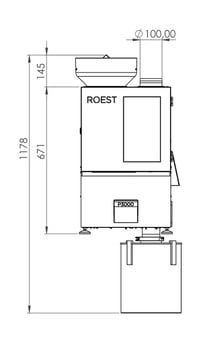
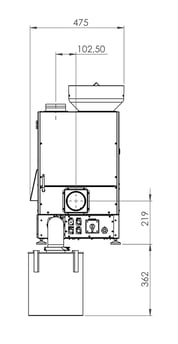
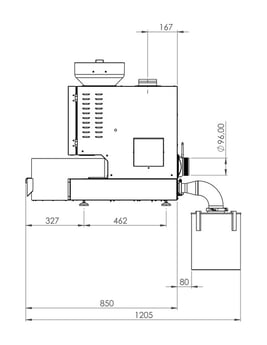
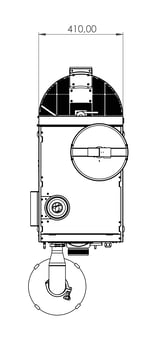
Main machine body dimensions: 410 mm (width) x 850 mm (depth) x 816 mm (height). Please also see the installation drawings on the ROEST support portal for full technical details.
The chaff collection bin is located to the rear and hangs below the roaster, so the roaster needs to be positioned at the rear edge of the table in such a way as to allow room for the chaff collection behind the roaster.
Allow an additional 80 cm space on all sides of the roaster to allow access for cleaning and maintenance and ensure sufficient air circulation.
Empty machine weight: 80 kg
Shipping weight including pallet: up to 100kg
Shipping dimensions including pallet: approx 1000 mm x 550 mm x 1100 mm
Front elevation
|
Rear elevation
|
Side elevation
|
Plan
|
Electrical
 Warning! This appliance must be earthed. Ensure the electrical supply is properly grounded.
Available configurations are as follows:
- 3P-400: 5-pin (3P+N+E) three-phase: 400 V, 10.24 kW, 50–60 Hz.
- 3P-230: 4-pin (3P+E) three-phase: 230 V, 10.24 kW, 50–60 Hz.
- 3P-208: 4-pin (3P+E) three-phase: 208 V, 9.9 kW, 50–60 Hz. Maximum branch circuit Overcurrent Protective Device (OCPD) rating: 30A
- 1P-230: Single phase: 230V, 7.1 kW, 50–60 Hz.
The desired configuration must be specified at the time of purchase.
Supplied plugs and cords
N.B. All versions of P3000 shipped to the US are supplied with the cord only and no plug. A qualified electrician must select and install a suitable plug and ensure the electrical installation of the machine is compliant with all local regulations
3P-400: supplied with a 1.5 m power cord (H07RN-F 5G 2.5mm2) and a standard CEE-form plug (16A, 5-pole, 6h).
3P-230: supplied with a 1.5 m power cord (H07RN-F 4G 4mm2) and a standard CEE-form plug (32A, 4-pole, 9h).
3P-208: supplied with a 1.5m power cord (SOOW 8/4) but no plug. A qualified electrician must select and install a suitable plug, and ensure the electrical installation of the machine is compliant with all local regulations. Use a UL 498 listed grounding type plug rated for 208 volts, 30 amperes, 3 phase, 3 wire (we suggest NEMA L15-30P).
1P-230: supplied with a 1.5 m power cord (H07RN-F 3G 4mm2) and a standard CEE-form plug (32A, 3-pole, 6h).
Connecting the roaster
If the correct socket type is already installed and connected to a suitable breaker, then you can simply plug the roaster in. Otherwise, a qualified electrician must install the socket and an appropriate breaker.
Alternatively, the roaster can be connected via a rotary isolator switch connected to an appropriate breaker. This installation must be carried out by a qualified electrician.
Using a phase converter
Where a three-phase supply is not available, it may be possible to connect the three-phase versions of the machine via a phase converter. We have not tested any particular models or types in-house and so cannot guarantee that the roaster will work correctly with all phase converter setups. If you are installing a phase converter, please keep the following in mind:
- The phase converter must be able to provide the full rated power of the machine on a sustained basis. Many phase converters (for example, those used to power three-phase motors) are designed to provide their maximum rated power for only a short time.
- The phase that powers the bean cooler fan must be connected to the supply legs only. The other phases can be connected to the manufactured leg. Please contact support for help identifying which cables correspond to the bean cooler fan before connecting the machine to the phase converter.
- We still recommend installing a plug and socket between the phase converter and the machine if possible, to allow easy disconnection for maintenance and moving the machine.
Ventilation
The P3000 must be connected to external ventilation, and used in a well-ventilated area. Ducting must be accessible for sweeping/cleaning.
The P3000 has two 100mm outlets, one for the bean cooler and one for the drum exhaust. For optimum performance and consistency, we recommend installing separate ducting for the cooling tray and drum exhaust. If necessary, it's possible to merge the two outlets into a single line using a Y-shaped connector with a larger-diameter outlet (min: 150 mm).
We recommend keeping ducting runs as short and with as few bends as possible. Where bends are required, they should be at 45 degrees (or less) rather than 90 degrees, to minimise disruption to airflow.
Ducting should be smooth-walled - we do not recommend flexible ducting be used for permanent installations.
Longer ducting runs, or those with multiple bends, may require an external fan to maintain neutral/negative pressure in the duct.
All ducts and joints must be fully sealed; the P3000 operates at positive pressure and no leakage is permissible.
The roaster also requires a supply of clean cold air: the intake is on the right-hand side panel of the machine.
Additional specifications:
- Drum exhaust outer diameter 100 mm (to accommodate 100 mm inner diameter duct).
- Cooling tray exhaust outer diameter 100mm (including silicone gasket).
- Built-in cyclone to separate chaff from drum exhaust.
- Dual mesh filter to separate chaff from cooling tray exhaust.
- Max airflow from drum exhaust in normal use 130 m3/h (77 CFM).
- Max airflow from cooling tray in normal use 380 m3/h (224 CFM).
- Drum exhaust ducting min. rating 260 °C.
- Bean cooler ducting min. rating 150 °C.
- All ventilation must be connected with positive pressure ducting, double-walled recommended.
- All ventilation connections must be fully sealed but easily removable for cleaning.
- All ventilation connections must be self-supporting, to ensure the roaster can easily be disconnected and moved for cleaning and maintenance.
- Minimum diameter of all ducting: 100 mm (150 mm if 2 lines are merged).
- We do not recommend using flexible ducting for permanent installations.
- Ducting must keep out rain.
- All duct terminations should be designed to minimise resistance to airflow and be accessible for cleaning. We recommend simple rain caps on vertical terminations and wide-mesh bird screens on horizontal terminations. Avoid baffles and fins to minimise resistance to airflow and avoid excessive build-up.
Noise
One of our design goals for the P3000 was to reduce noise wherever possible. Actual noise levels will vary depending on installation and roasting conditions. For example, double-walled insulated ducting can significantly reduce fan noise.
During roasting, the main noise sources are bean movement inside the drum and the fans. These are reflected in the mean sound level measurement below. The peak sound pressure level occurs briefly during drop and is primarily caused by the beans falling into the cooling tray.
The following measurements were taken at the operator position, under normal operating conditions:
-
Mean A-weighted SPL: 68.7 dB(A)
-
C-weighted peak SPL: 80.6 dB(C)
Connectivity
To use all the machine’s features, it must be connected to the internet. The connection can be made via Wi-Fi or the ethernet port at the rear of the machine. The Wi-Fi connection can be configured directly from the roaster’s touchscreen. For detailed instructions, please see the guides at support.roestcoffee.com.
A stable internet connection is required for datalogging, inventory management, and to modify and download roast profiles. The roaster can be operated without an internet connection using pre-loaded profiles or by roasting with manual control.
- Wi-Fi dual-band 802.11ac (2.4GHz / 5GHz)
- Gigabit ethernet
- USB-C (for debugging)
Capacity
Batch size: 1–3 kg
Batch time: 6+ minutes
Maximum output: 25+ kg/hr